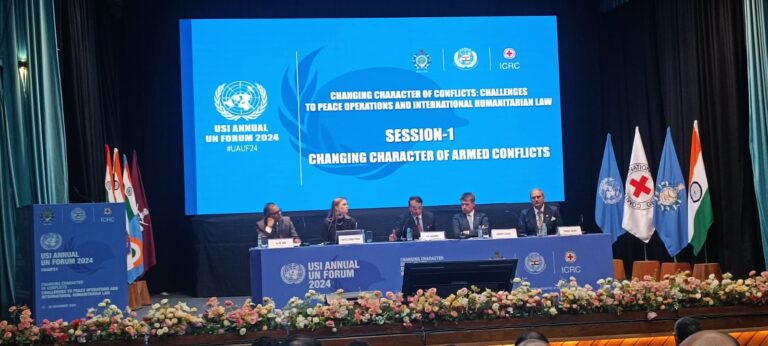
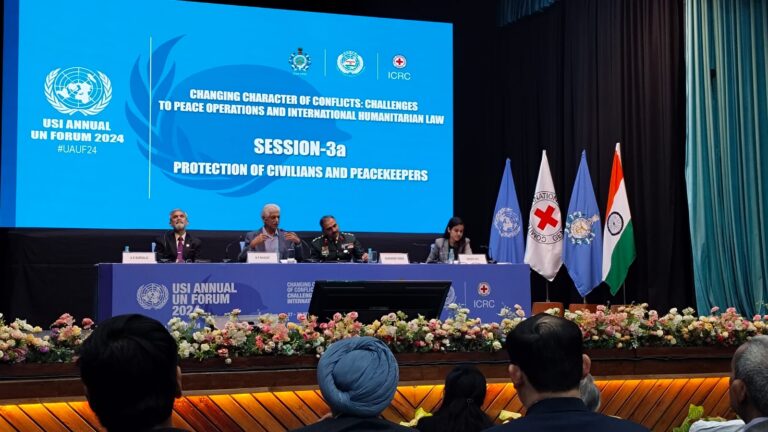
The United Service Institution of India (USI), New Delhi, proudly organized the USI Annual UN Forum 2024 on November 27–28, 2024. Themed “Changing Character of Conflicts: Challenges to Peace Operations and International Humanitarian Law (IHL),” the forum provided a unique platform for students, academics, scholars, veteran military personnel, bureaucrats, and active servicemen to engage in stimulating discussions. Abhishek Shaw and Daivam Nishanth, the student representative of the Assembly of Nations, went on behalf of the college, the BESC. The event was structured across four thematic sessions, focusing on key issues such as civilian protection, accountability for crimes against peacekeepers, climate-driven conflicts, and the pivotal role of women in peace operations.
Day 1: Inaugural Session and Early Discussions
The program began with welcome remarks from Maj Gen PK Goswami (Retd), Deputy Director General, USI, followed by an opening address by Maj Gen BK Sharma (Retd), Director General, USI, who set the stage for two days of insightful deliberations.
Special Address: Ruchira Kamboj
Ruchira Kamboj, India’s Former Permanent Representative to the United Nations, delivered a compelling special address, sharing deep insights into the UN’s functioning and India’s leadership in global peacekeeping. She highlighted India’s sacrifices in peace operations, its resolutions in the UN General Assembly, and its role in fostering a culture of peace, financial stability for the UN, and addressing climate-related issues.
Her speech underscored the evolving nature of conflict from intrastate to interstate and the growing challenges posed by funding shortages, with underfunded missions like those in Mali and Sudan serving as prime examples. She stressed the importance of involving local communities, reforming veto powers, modernizing IHL, and promoting inclusivity in peace operations, concluding with a profound thought: “Wars today impact entire societies, with civilians bearing the greatest burden.”
Session 1: Changing Character of Armed Conflict
Chaired by Maj Gen BK Sharma (Retd), this session examined the evolution of armed conflicts with insights from distinguished panellists:
Maj Gen Alok Deb (Retd) analysed trends in multidimensional conflicts.
Maj Gen (Dr) Pawan Anand (Retd) discussed the impact of technology on modern warfare.
Ingvild Brodtkorb, Research Fellow, NUPI, explored climate emergencies and their links to conflicts.
Dr Andrei Kozik, Regional Legal Advisor, ICRC, examined how changing conflict dynamics affect IHL.
The session emphasized how conflicts have shifted, with over 187 recorded armed conflicts between 1900 and 2022. Discussions touched on cyber-kinetic warfare, the weaponization of technology, and space militarization, while also proposing potential reforms for the UN’s operational mandates.
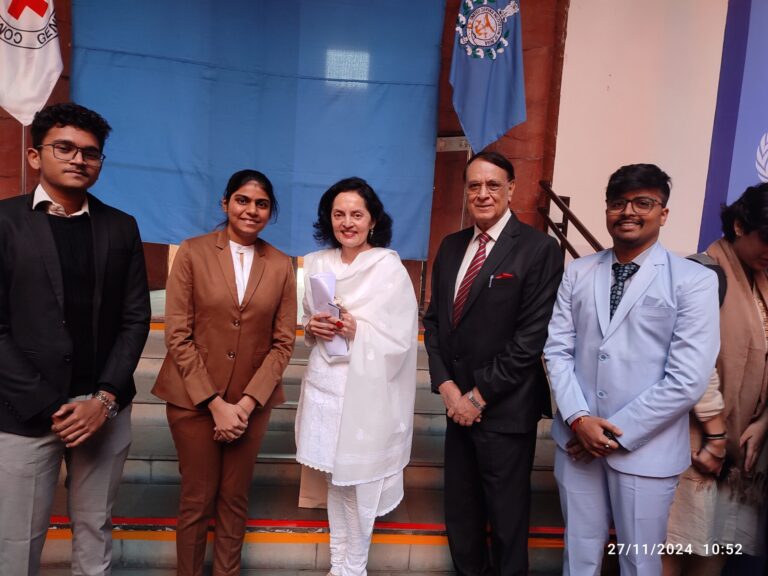
Session 2: Evolving Conflicts – Challenges to Peace Operations and IHL
Chaired by Dr Andrei Kozik, this session focused on the challenges faced by peace operations in the context of evolving conflicts:
Kath Stewart discussed the role of IHL in peacekeeping.
Prof. Bharat Desai highlighted the UN Security Council’s role in strengthening IHL.
Ms. Annika Hilding Norberg addressed future challenges to UN peacekeeping.
The panel delved into topics such as the disruptive role of technology, the complexities of internationalized civil wars, and the transformative power of respecting IHL to ease paths toward peace.
Day 2: Focused Discussions and Breakout Sessions
Opening Address: Amb. Asoke Mukerji
Amb. Asoke Mukerji, India’s Former Permanent Representative to the UN, reflected on India’s legacy in peacekeeping, including the deployment of the first all-female unit to Liberia in 2007. He highlighted India’s commitment to inclusive participation and “Make in India” initiatives, such as deploying 150 armoured vehicles to South Sudan. He proposed political support, financial investment, and systemic reforms as solutions to enhance peace operations.
Session 3: Breakout Discussions
(A) Protection of Civilians and Peacekeepers
Chaired by Maj Gen MP Bhagat (Retd), this session focused on:
Threats to Civilians and Peacekeepers by Maj Gen (Dr) AK Bardalai (Retd).
Institutional Measures to Protect Peacekeepers by Brig Narender Singh.
IHL and Civilian Protection by Meher Dev, ICRC.
Discussions highlighted the massive displacement of civilians in conflicts and the rising need for effective protection mechanisms for peacekeepers.
(B) Women in UN Peace Operations – Key to Lasting Peace
Chaired by Ms. Susan Ferguson, UN Women India, this session explored:
Challenges for Women Peacekeepers by Col (Dr) KK Sharma (Retd).
Advancing Women in Peacebuilding by Ms. Annika Hilding Norberg.
Field Experiences by Major Navita Kashyap.
The session delivered firsthand experience of the peacekeeping officers who work with local communities on daily basis and how they try to break the barriers by simple and indigenous methods, such as establishing connection through Bollywood references.
Session 4: Future Challenges of UN Peace Operations
Chaired by Lt Gen JS Lidder (Retd), the session analysed the future of peacekeeping:
Ms. Annika Hilding Norberg discussed leveraging the “Pact of the Future” and the “New Agenda for Peace.”
Col (Dr) KK Sharma (Retd) emphasized people-centric operations as a key to success.
Sandeep Bali, ICRC, explored behavioural restraints and the importance of IHL compliance.
The session highlighted that the future success of UN peace operations depends on adopting innovative frameworks, prioritizing community-centred strategies, and maintaining strict adherence to International Humanitarian Law. These measures will improve the adaptability of peace operations to modern conflict complexities and promote lasting global peace.
Conclusion
The USI Annual UN Forum 2024 was a resounding success, fostering a deeper understanding of the changing nature of conflicts and the critical role of peace operations and IHL. With actionable insights and proposed reforms, the forum underscored the need for collective global efforts to address modern conflict dynamics and uphold peace and security worldwide.
The conference gave Abhishek Shaw and Daivam Nishanth, the representatives of the Assembly of Nations, a MUN society, an opportunity to holistically understand and engage in dialogues on the theme of the conference, which is immensely relevant in today’s dynamic world, with experts from the field. The knowledge and perspectives we gained will be instrumental in shaping our upcoming events, such as the Intra MUN on January 6-7, 2025, and AON’25 from April 24-27, 2025. They aim to foster similarly impactful dialogues and initiatives during these events, building on the momentum and insights from the forum.
Report prepared by Abhishek Shaw & Daivam Nishanth
“Research is seeing what everybody else has seen and thinking what nobody else has thought.” – Albert Szent-Györgyi The Bhawanipur Education Society College organised a two-day interactive session on how to write a Research Paper. The session was held on January 17 and 18, 2024 from 11.00 am in the Society Hall of the college. …
The much anticipated import and export workshop started on Wednesday, 14th January, 2015 with joint efforts of the volunteers, who managed to bring an experienced industrialist as well as a professor to renowned institutions Prof Saibal Chatterjee. The workshop continued for five days which included a last day factory visit. Day 1 (14th January): Prof. …
The Bhawanipur Education Society College was awarded Best Institute for Promoting Industry Academia Linkage 2021 at the “The EduMeet– 2021 Education & Skill Industry Excellence Awards” by Associated Chambers of Commerce and Industry of India (ASSOCHAM). The award was conferred at the Lalit Great Eastern Hotel in Kolkata on November 19, 2021 by Sri. K. …
Name of the Activity: 30 hour duration Add on Course Type of Activity: Academic Duration: 31st October 2025 to 9th February 2026 No. of Participants: Students-10, Non-Teaching Staff-05, Teaching Staff-08 Objective of the event: The main objective of this add-on course in Physics was to provide students with additional knowledge and practical skills beyond the …
USI Annual UN Forum 2024: Changing Character of Conflicts – Challenges to Peace Operations and International Humanitarian Law
The United Service Institution of India (USI), New Delhi, proudly organized the USI Annual UN Forum 2024 on November 27–28, 2024. Themed “Changing Character of Conflicts: Challenges to Peace Operations and International Humanitarian Law (IHL),” the forum provided a unique platform for students, academics, scholars, veteran military personnel, bureaucrats, and active servicemen to engage in stimulating discussions. Abhishek Shaw and Daivam Nishanth, the student representative of the Assembly of Nations, went on behalf of the college, the BESC. The event was structured across four thematic sessions, focusing on key issues such as civilian protection, accountability for crimes against peacekeepers, climate-driven conflicts, and the pivotal role of women in peace operations.
Day 1: Inaugural Session and Early Discussions
The program began with welcome remarks from Maj Gen PK Goswami (Retd), Deputy Director General, USI, followed by an opening address by Maj Gen BK Sharma (Retd), Director General, USI, who set the stage for two days of insightful deliberations.
Special Address: Ruchira Kamboj
Ruchira Kamboj, India’s Former Permanent Representative to the United Nations, delivered a compelling special address, sharing deep insights into the UN’s functioning and India’s leadership in global peacekeeping. She highlighted India’s sacrifices in peace operations, its resolutions in the UN General Assembly, and its role in fostering a culture of peace, financial stability for the UN, and addressing climate-related issues.
Her speech underscored the evolving nature of conflict from intrastate to interstate and the growing challenges posed by funding shortages, with underfunded missions like those in Mali and Sudan serving as prime examples. She stressed the importance of involving local communities, reforming veto powers, modernizing IHL, and promoting inclusivity in peace operations, concluding with a profound thought: “Wars today impact entire societies, with civilians bearing the greatest burden.”
Session 1: Changing Character of Armed Conflict
Chaired by Maj Gen BK Sharma (Retd), this session examined the evolution of armed conflicts with insights from distinguished panellists:
The session emphasized how conflicts have shifted, with over 187 recorded armed conflicts between 1900 and 2022. Discussions touched on cyber-kinetic warfare, the weaponization of technology, and space militarization, while also proposing potential reforms for the UN’s operational mandates.
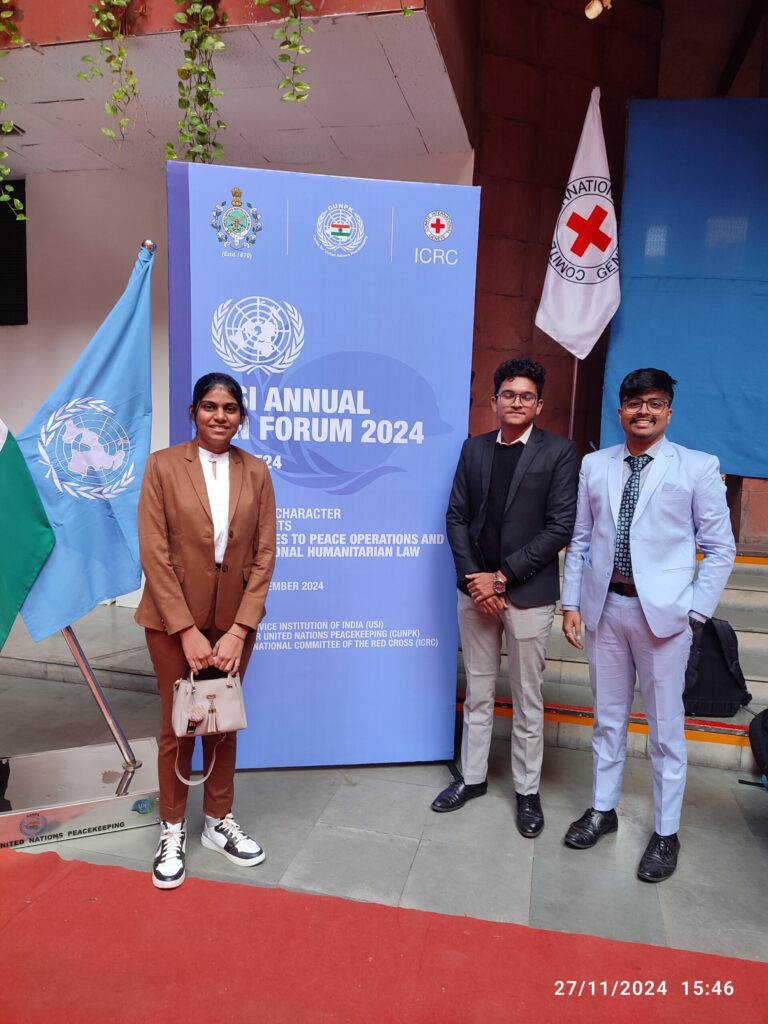
Session 2: Evolving Conflicts – Challenges to Peace Operations and IHL
Chaired by Dr Andrei Kozik, this session focused on the challenges faced by peace operations in the context of evolving conflicts:
The panel delved into topics such as the disruptive role of technology, the complexities of internationalized civil wars, and the transformative power of respecting IHL to ease paths toward peace.
Day 2: Focused Discussions and Breakout Sessions
Opening Address: Amb. Asoke Mukerji
Amb. Asoke Mukerji, India’s Former Permanent Representative to the UN, reflected on India’s legacy in peacekeeping, including the deployment of the first all-female unit to Liberia in 2007. He highlighted India’s commitment to inclusive participation and “Make in India” initiatives, such as deploying 150 armoured vehicles to South Sudan. He proposed political support, financial investment, and systemic reforms as solutions to enhance peace operations.
Session 3: Breakout Discussions
(A) Protection of Civilians and Peacekeepers
Chaired by Maj Gen MP Bhagat (Retd), this session focused on:
Discussions highlighted the massive displacement of civilians in conflicts and the rising need for effective protection mechanisms for peacekeepers.
(B) Women in UN Peace Operations – Key to Lasting Peace
Chaired by Ms. Susan Ferguson, UN Women India, this session explored:
The session delivered firsthand experience of the peacekeeping officers who work with local communities on daily basis and how they try to break the barriers by simple and indigenous methods, such as establishing connection through Bollywood references.
Session 4: Future Challenges of UN Peace Operations
Chaired by Lt Gen JS Lidder (Retd), the session analysed the future of peacekeeping:
The session highlighted that the future success of UN peace operations depends on adopting innovative frameworks, prioritizing community-centred strategies, and maintaining strict adherence to International Humanitarian Law. These measures will improve the adaptability of peace operations to modern conflict complexities and promote lasting global peace.
Conclusion
The USI Annual UN Forum 2024 was a resounding success, fostering a deeper understanding of the changing nature of conflicts and the critical role of peace operations and IHL. With actionable insights and proposed reforms, the forum underscored the need for collective global efforts to address modern conflict dynamics and uphold peace and security worldwide.
The conference gave Abhishek Shaw and Daivam Nishanth, the representatives of the Assembly of Nations, a MUN society, an opportunity to holistically understand and engage in dialogues on the theme of the conference, which is immensely relevant in today’s dynamic world, with experts from the field. The knowledge and perspectives we gained will be instrumental in shaping our upcoming events, such as the Intra MUN on January 6-7, 2025, and AON’25 from April 24-27, 2025. They aim to foster similarly impactful dialogues and initiatives during these events, building on the momentum and insights from the forum.
Report prepared by Abhishek Shaw & Daivam Nishanth
Related Posts
Session On How to Write a Research Paper
“Research is seeing what everybody else has seen and thinking what nobody else has thought.” – Albert Szent-Györgyi The Bhawanipur Education Society College organised a two-day interactive session on how to write a Research Paper. The session was held on January 17 and 18, 2024 from 11.00 am in the Society Hall of the college. …
Export-Import Workshop
The much anticipated import and export workshop started on Wednesday, 14th January, 2015 with joint efforts of the volunteers, who managed to bring an experienced industrialist as well as a professor to renowned institutions Prof Saibal Chatterjee. The workshop continued for five days which included a last day factory visit. Day 1 (14th January): Prof. …
ASSOCHAM Award
The Bhawanipur Education Society College was awarded Best Institute for Promoting Industry Academia Linkage 2021 at the “The EduMeet– 2021 Education & Skill Industry Excellence Awards” by Associated Chambers of Commerce and Industry of India (ASSOCHAM). The award was conferred at the Lalit Great Eastern Hotel in Kolkata on November 19, 2021 by Sri. K. …
Rephysica 2025 – A Frontier
Name of the Activity: 30 hour duration Add on Course Type of Activity: Academic Duration: 31st October 2025 to 9th February 2026 No. of Participants: Students-10, Non-Teaching Staff-05, Teaching Staff-08 Objective of the event: The main objective of this add-on course in Physics was to provide students with additional knowledge and practical skills beyond the …